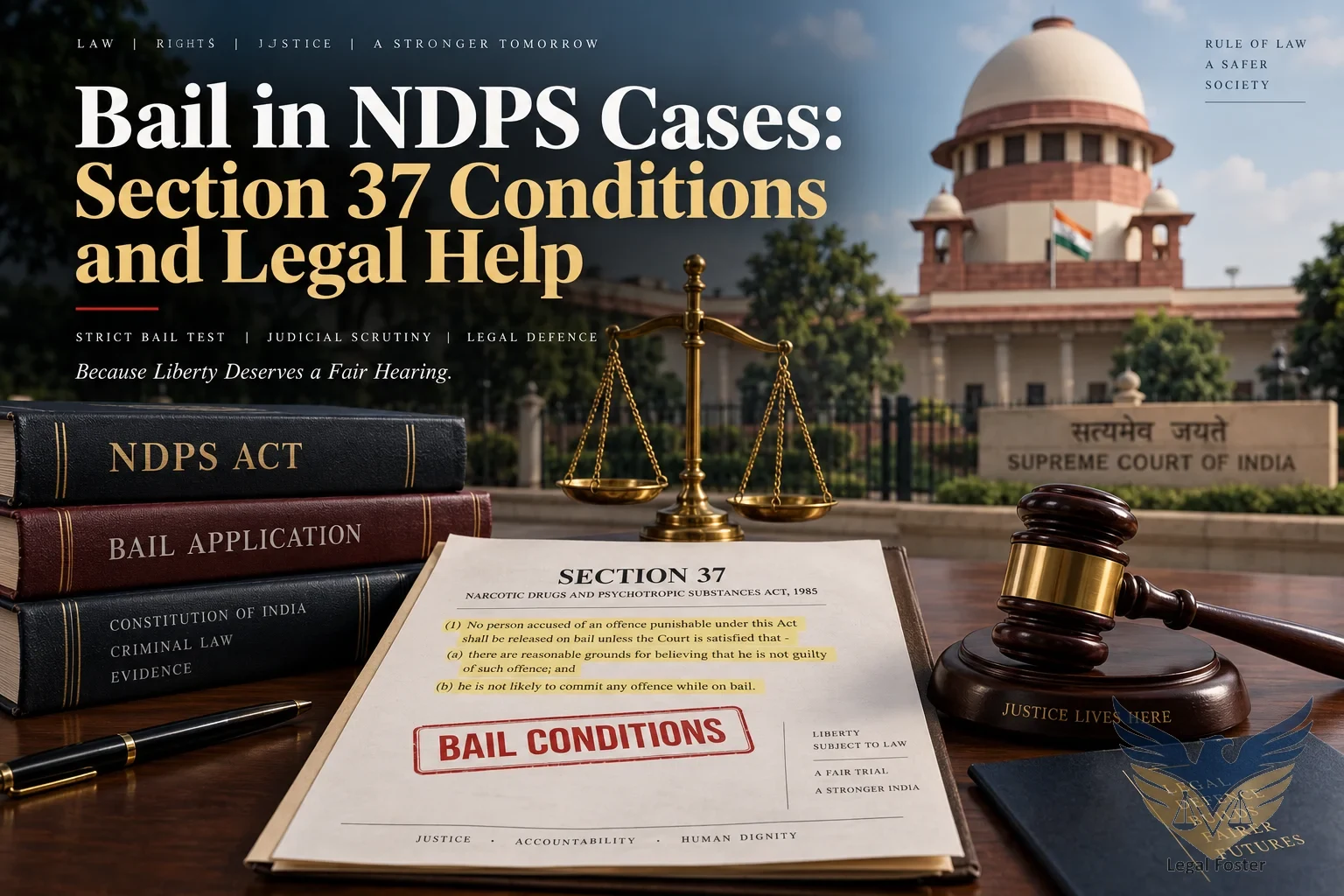
How to Get Bail in NDPS Cases Under Strict Bail Conditions?
An NDPS arrest can shatter a family’s life overnight. Your friend, relative or even your spouse can be arrested and produced by police tomorrow morning on allegations of possessing, recovering, transporting or conspiring to commit or offences in commercial quantity. Naturally, the first question your family members will ask you is pretty straight forward. How do we get bail if the NDPS Act specifically prohibits bail!
Nothing works like understanding the legal language NDPS bail differs from criminal bail. In layman’s terms, Section 37 NDPS Act imposes additional bail conditions for offences under Sections 19, 24 and 27A of NDPS Act and allegations of commercial quantity. If the investigation and arrest happened in a manner that attracts Section 37 NDPS, it automatically applies to the ongoing NDPS case.
It’s mandatory to afford opportunity to P.P. to oppose bail. Secondly, the Court must consider and satisfy the two statutory conditions precedent to hearing bail on merits.
We will walk through a bail application after reading the FIR/complaint. The facts of the case will matter for any accused or family member looking for bail lawyer for NDPS arrest cases. Instead of drafting one bail petition, it is helpful to understand the exact offence, quantity alleged, facts of recovery, stage of custody, previous history and what records are available.
Advocate BK Singh will read the FIR/complaint, remand documents, seizure and other evidence, identify the relevant Sections of NDPS Act and determine the current stage of the matter. Any bail application must always be linked to the provisions of law that apply to that specific accused.
Counsel cannot go into Court with boilerplate bail arguments that are heard in regular criminal matters. Those bail conditions and laws will not apply if Sections 37 and/or 37/38 NDPS apply.
Under Section 37 NDPS Act, bail standard is strict. But a strict standard does not mean no NDPS accused will get bail. The Courts look into each statutory requirement, assess the relevant facts already on record, time period in custody, nature of prosecution evidence, and other facts and circumstances of the case. In fact, the Supreme Court itself has in 2026 bail judgments clarified how to interpret Section 37 (special NDPS bail provisions) cases.
NDPS Arrests and Bail – Understanding Bail Applications in 2026
NDPS matters can arise in big cities or towns all over India. NDPS cases get filed in Delhi NCR cities such as Delhi, Ghaziabad, Noida, Gurugram and other cities all over Uttar Pradesh, Maharashtra, Rajasthan, Karnataka, Telangana, Tamil Nadu, West Bengal and India at large.
Procedure can vary from Local Court to Local Court but NDPS law remains the same everywhere. Does an NDPS matter begin in Police Station or get sent to Special Court? There are many other bail remedies depending on the facts of the case and which court has power. Section 36C of NDPS Act states,
“The provisions of this Code (37 of 1973.) relating to bail and bonds shall apply in relation to proceedings before the Special Court constituted under this Act, as they apply in relation to proceedings before the Court of Session, and, in particular, wherever in those provisions, imprisonment, substitute imprisonment, reference to the Court of Session or to any Court other than the Court of Session shall be read as reference to the Special Court.”
The Lok Adalat powers have also been amended along with criminal procedure laws. Bhariya Nagarik Suraksha Sanhita, 2023 came into force on 1st July 20 24 across India. BNSS Section 483 conferred special powers of bail on High Court and Court of Session. BNSS Section 482 explicitly deals with power to issue certain directions in special cases to a person who has reason to believe that he may be arrested.
Quick tip for families, first find out where police send accused. Determine the Court, stage of NDPS matter and specific offences mentioned in chargesheet prior to looking at bail options.
Quick Facts
- Offences under NDPS Act are cognizable & non-bailable offence under Section 37.
- Section 37 imposes additional conditions on bail for commercial quantity offences and certain enumerated serious offences under NDPS Act.
- Prosecutor has to be heard on the question of bail wherever Section 37 is applicable.
- Court must examine both the twin statutory conditions precedently before adjudicating bail on merits in eligible Section 37 NDPS cases.
- Grant of bail is not tantamount to closure of NDPS case ab initio or an acquittal.
- Extended police investigation in serious NDPS cases including commercial quantity offences is dealt under Section 36A(4).
- Factors like investigated recovered quantity, accused’s actual involvement, stage of custody, other imminent evidence etc can be considered during bail hearing.
What Makes Bail Difficult Under the NDPS Act?
NDPS bail applications become harder when the prosecution has made allegations about commercial quantity or has invoked Sections 19, 24 or 27A to initiate the NDPS chargesheet. Section 37 mandates that opportunity be given to the Public Prosecutor to oppose the application for bail. He may oppose, in which case bail can be granted only if court is satisfied that
- The accused is not guilty of that offence; and
- He is not likely to commit any offence while on bail.
Both these criteria have been held by the Supreme Court to be strict statutory limitations. In fact in a recent judgment 2026, the Supreme Court reiterated that the prerequisites of Section 37 cannot be wished away in a matter to which it is applicable.
Which brings us back to the facts of the record. Merely saying to the Judge that this allegation is false may not satisfy the requirements statutorily laid out. It is very likely that the bail court will have to look into the recovery as alleged in the challan, go through documents, statements, role imputed to the accused, quantum involved to see if it is of commercial nature, antecedents and any other material on record at the time of bail hearing.
BK Singh can guide a family through this exercise to see which of these are actually applicable to the accused instead of dealing with every NDPS arrest alike.
What Laws and Bail Provisions Apply?
The principal legislation is NDPS Act. Section 37 is special bail restrictions and limitations. Sections 19, 24 and 27A are highlighted under Section 37. Complaints of commercial quantity invoke statutory limitations/restrictions.
Section 36A comes into play as well. Certain NDPS offences have an increased period of investigation if they include offences under Section 19 (commercial quantity). So the general 60/90 days under criminal law for investigation is no longer applicable and can be extended up to 180 days. Moreover the Special Court may extend this period upon application made to it along with a report from the Public Prosecutor up to a total period of 1 year.
After the expiry of this period, investigation not completed, this provision may well come into play for default/statutory bail if the circumstances are met to satisfy the law. The Supreme Court has gone as far to acknowledge the importance of the statutory bail right if the period expires and the accused seeks to exercise that right.
Courts give bail nowadays primarily under BNSS. Section 483 refers to special powers of High Court or Court of Session are special in nature relating to grant of bail. Section 482 refers to preventive of anticipatory bail in which someone thinks they are about to be arrested for a offence which is non-bailable.
It is important to understand how the NDPS Act plays with normal criminal procedure. Figure out what special restriction applies first as an NDPS lawyer and than go for the procedural remedy.
Who Usually Needs Help With NDPS Bail?
NDPS bail can come into play when an accused has been arrested. It can come into play when a relative wants to know why their loved one has been taken into custody. It can also come into play when someone has a real threat of arrest under a serious NDPS allegation.
Some situations where NDPS bail can help are:
- possession of narcotics/drugs, psychotropic substances or pharmaceutical ingredients;
- delivery or transportation; accumulating ;
- commercial quantity of seized material;
- conspiracy/abetment;
- others’ statements being used to implicate the person in it;
- electronic chats, call logs or bank transactions; and
- previous arrest and bail denial
- long period of custody; or
- problems with default/statutory bail.
Each accused person is unique. Just because something is appropriate for one co-accused does not mean the same relief applies to others.
How Does the NDPS Bail Procedure Typically Unfold?
-
1. FIR/complaint and arrest status is confirmed
Check out the FIR/complaint and confirm the arrest status of the individual before beginning to draft the bail application. What sections are invoked under NDPS? How much quantity? What’s the seizure allegation? Where was it recovered from? Who’s allegedly involved? Are they in custody?
If they haven’t been arrested yet, the legal issue will likely be different than a typical bail application after arrest. The remedy will depend on the facts and applicable law.
-
2. Alleged quantity is verified
The quantity of drugs involved is often the key issue in an NDPS bail application. This is because there are statutory differences on bail based on whether a commercial quantity is alleged or not.
Regardless, never take the alleged quantity from a police report at face value. Check the seizure case papers and look for the alleged quantity of the substance mentioned under the relevant notification & record.
-
3. Custody/status in court is determined
Whether the accused is in police custody for arrest, remand, investigation, is at the charge-sheet stage, or trial stage will change the legal analysis. Did the court pass an order on bail previously?
Families should maintain their own copies of court orders. If a petition has been dismissed, you cannot safely draft a new application as if the court has never heard of the matter.
Click here to read our comprehensive post on bail forums in Sessions Courts.
-
4. Statutory bars are analyzed
If NDPS Section 37 applies to the facts, then the bail application needs to focus on the statutory language. It cannot simply focus on personal circumstances.
The Court may also take note of the material on record at the time of hearing the bail application. Cops will have an opportunity to confirm/rebut the facts in the bail application. Ensure that arguments are crafted towards bail and not based on false information.
-
5. Correct Court is ascertained
NDPS bail applications can be presented in Special Court, Sessions Court, or the High Court. Based on what court has passed orders previously, you’ll need to identify the correct forum.
People cannot expect that if they got denied bail from a Sessions Court that the High Court will review everything from scratch. Prior orders will be taken into consideration, along with any new information.
Read this to learn more about High Court bail applications if you’re looking to approach a higher court after bail was rejected.
-
6. Bail conditions are read before leaving jail
Bail doesn’t always mean you’ll walk out of jail. Depending on what the judge orders, there may be certain conditions about appearances, cooperating with investigations, no travel, no contact with witnesses, sureties, or something else.
If bail is granted, READ THE ORDER. Conditions of bail are not suggestions. If they are violated, the accused could get into more trouble including cancellation of bail.
Documents and Evidence
It can vary depending on the facts. But generally, for an NDPS bail hearing you will want to have the following documents/material:
| Document/ |
Purpose |
|---|---|
| FIR/ |
What allegations / |
| Memo of arrest/ |
Where the accused has come from custody and how the accused has been proceeding |
| Documents of seizure/ |
To know what has been alleged to be recovered/ |
| Material related to FSL, if any | May help you analyse what the seized substance is.. |
| Any bail orders from lower courts | Helps you know what previous courts have observed and how the matter has been proceeding |
| Charge-sheet, if filed | What stage of investigation has been reached |
| Identity/ |
Could be handy for bail conditions/ |
| Medical/ |
Could help you establish certain facts |
| Info on other cases the accused is involved in | Helps you correctly analyse antecedents |
Keep them in one file. Editing quickly at the hearing will save precious time. DON'T tweak/delete/produce any document to make your bail application look artificially good. It’s always best to keep originals untouched and let your lawyer analyze their legal worth.
When is the right time to speak to an NDPS bail lawyer?
You should speak to a lawyer as soon as possible if an NDPS FIR is registered against you or your family member, searches/seizure has been carried out or a family member/relative has been arrested, remand proceedings are pending/appearing likely or arrest is seriously apprehended. You should also speak to a lawyer if bail has already been rejected, if the accused has already spent considerable time in custody, if the charge- sheet has been filed or if your family thinks that the period for investigation might attract legal consequences.
If arrest is feared, the procedure for getting bail is slightly different than the bail after arrest (regular bail). See our anticipatory bail page for a summary of the general position under the new criminal laws. BK Singh will review your case papers and advise whether the immediate need is for anticipatory bail, regular bail, statutory bail or relief from a higher court or compliance with a existing bail order.
How Best Bail Lawyer Can Help With NDPS Bail?
Best Bail Lawyer provides information and assistance on bail and criminal defense law topics All over Delhi NCR & India as jurisdiction allows and case merits.
NDPS – THE ONLYthing YOU SHOULD EVER focus on IS THE RECORD. FIR/complaint, alleged quantity, seizure material, chain of custody, sections, previous orders and WHERE THE CASE STANDS TODAY in Court.
High Court bail under NDPS is highlighted in a separate post. Once an earlier order is passed/highcourt becomes Jurisdiction or at the correct stage in the pendency.
Advocate BK Singh can NOT promise you that you will get bail. Only the Court can decide that based on law and facts of that particular case. What your legal counsel can ensure is that we identify & bring up all legal issues/applicable documents.
FAQs
1. Can I get bail in commercial quantity NDPS case?
Ans. Yes. Bail is neither barred nor restricted per se and same can be filed in the court of law. The concern that Section 37 imposes strict conditions in relevant cases which come under commercial quantity need to be understood. Court needs to give opportunity to Public Prosecutor to oppose bail application & needs to be satisfied with statutory conditions before entertaining bail application on merits.
2. What are twin conditions in Section 37 NDPS?
Ans. Prosecution opposes bail under Section 37. Court needs to be satisfied that there are reasonable grounds for believing that:
- (i) Accused is not guilty of the offence
- (ii) Accused is not likely to commit any offence while on bail
3. Does Section 37 NDPS apply to every bail application under NDPS?
Ans. Section 37 NDPS provides additional restrictions for offences under Sections 19, 24 and 27A read with offences involving commercial quantity. Exact allegations & quantity involved needs to be seen before deciding applicability of this provision.
4. Can I apply for bail after charge-sheet is filed against me under NDPS?
Ans. Yes. You can apply for bail even after charge-sheet is filed. However when charge-sheet is filed against you, this fact alone does not entitle you with loss of statutory rights or eligibility for regular bail. Relevant statutory restrictions and circumstances prevailing at that stage would be considered by the court.
5. Can default bail be applied for in NDPS cases?
Ans. Yes. Issue of statutory/ default bail gets attracted where applicable period of investigation exceeds without being completed in accordance with law. Section 36A(4) NDPS Act clearly mentions that for certain enumerated offences of serious NDPS nature, investigation has to be completed in 180 days. Only period extension upto one year is allowed to authorities which is subject to conditions provided in the statute itself.
6. Will my friend get released as soon as it completes 180 days?
Ans. No. Not merely because 180 days are over. Entire calculation needs to be seen along with relevant offence involved, order extending time, stage of investigation upto which it was completed & whether statutory right was invoked at the correct stage. Supreme Court has held that right to default bail should be invoked at the correct stage when it accrues.
7. If I get bail does it mean I am acquitted of NDPS charges?
Ans. No. It just means that accused have been released from jail on certain conditions as directed by the court. Charges against him for offence continue.
8. Can High Court hear bail applications under NDPS?
Ans. Yes. High Court has powers under criminal procedural law along with specific restrictions for granting bail under NDPS. Power of High Court & Court of Session for grant of bail is specifically conferred under Section 483 BNSS subject to restrictions of law.
9. If one co-accused gets bail order, will the court pass same order for all co-accused?
Ans. Benefit of one co-accused cannot be superimposed on another automatically. Each accused is treated on their individual merits but sometimes courts can decide to grant same relief based on principle of parity. But there can be difference in role of each accused as considered by court, quantity of drugs recovered, evidence against each accused, antecedents of each accused, time spent in jail and other facts. Hence one has to be cautious before commenting that what has been granted to one co-accused will be granted to another.
10. Can I trust Advocate BK Singh to get bail in my NDPS case?
Ans. No lawyer can assure you that you will get bail. Advocate BK Singh will only analyse the records available, point out statutory angles which need to be considered and suggest you the legal course which could be adopted. Decision will be taken by the courts.
Conclusion
Bail under NDPS is not something that you can file a regular bail application and secure. Section 37 creates a very high statutory bar for bail, especially in cases involving commercial quantity or where the aforementioned specific aggravated NDPS offences are mentioned in the allegations. The alleged quantity/recovered material, the role of accused, length of custody already served, stage of investigation and previous orders passed are all factors that become relevant. If you have a loved one in Delhi NCR, Ghaziabad, Noida, Gurugram, Lucknow, Mumbai, Hyderabad, Bengaluru, Jaipur or anywhere else in India, have them preserve the entire case diary/disclosure material and seek specific legal advice based on the facts of their case rather than guessing from someone else’s bail order. Custody is often at issue, so time is of the essence. BK Singh can help you understand what papers you have available to you and the correct bail route, statutory limitations and procedural posture for the facts of your specific case.