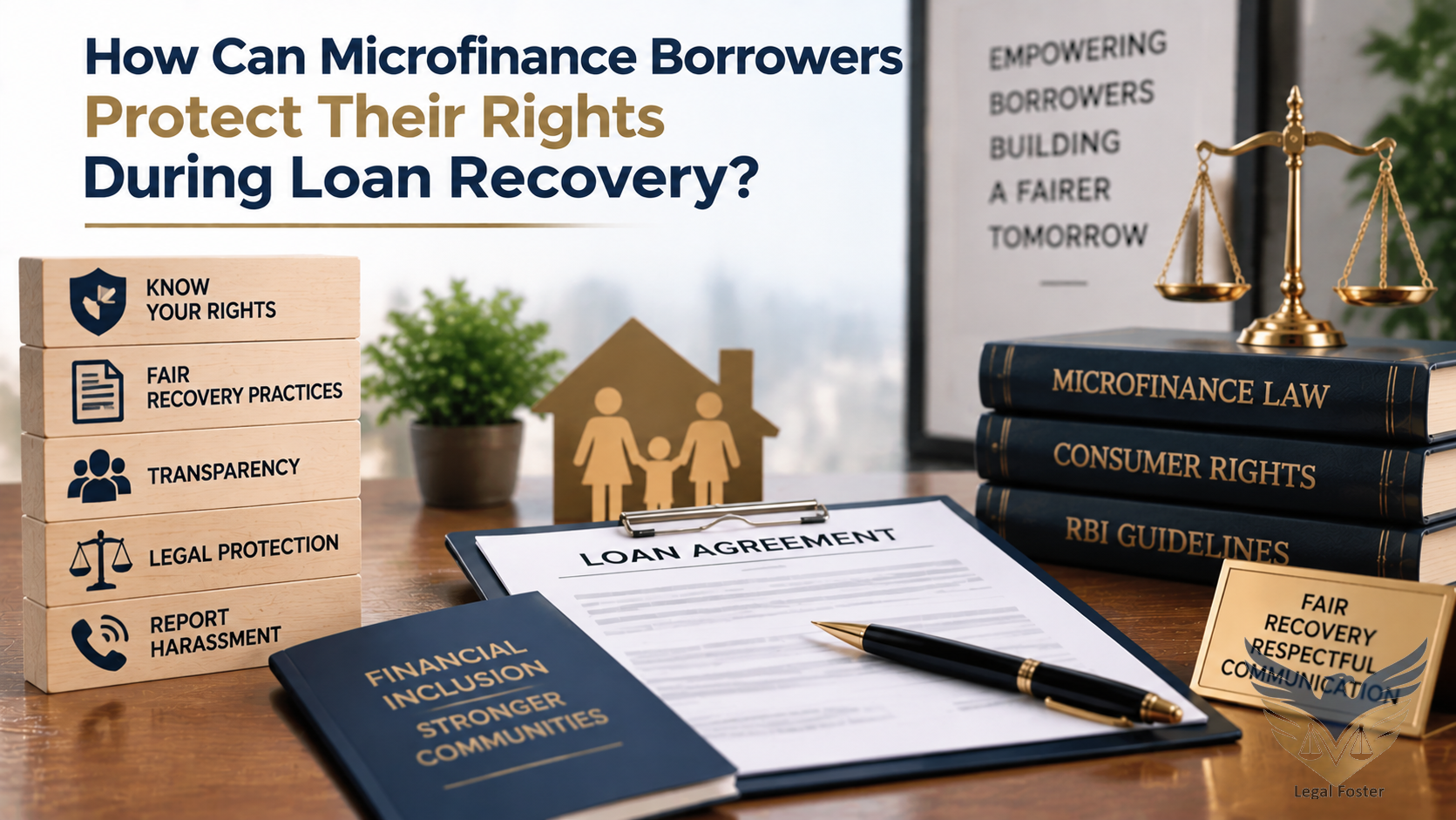
How Can Microfinance Borrowers Protect Their Rights During Loan Recovery Proceedings?
Practical guidance for borrowers dealing with MFI loan default, recovery pressure, settlement discussions and borrower rights.
Facing harassment over a microfinance instalment due can quickly become about a lot more than money. Borrowers are put on the receiving end of harassing phone calls, center meetings, home visits, public intimidation and contacting family members. In some cases, social stigma against women borrowers, SHG members and Joint Liability Group borrowers can be just as bad as anxiety over the outstanding amount.
Loan default doesn’t make someone ‘ debt free,’ but it does prevent lenders and recovery agents from bullying borrowers indefinitely. India’s microfinance regulation enables creditors to recover their dues, but also sets boundaries for healthy recovery vs. abusive practices. Borrowers should know both parts of that sentence: yes they should pay back what they owe, but they also have the right to dignity, privacy, respectful treatment and the ability to file a complaint.
Advocate BK Singh of Loan Settlement Agency suggests one set of questions borrowers ask at the onset: how much money is legitimately owed, whether or not the recovery methods being used are legal and what realistic repayment or settlement offer can be documented in writing. There is a difference between filing a harassment complaint against a lender and requesting loan settlement.
Borrowers in Delhi NCR, Delhi, Noida, Ghaziabad, Greater Noida, Gurugram, Faridabad, Lucknow, Jaipur, Mumbai, Pune, Bengaluru, Hyderabad, Kolkata, Ahmedabad and elsewhere in India can refer to the same basic RBI guidelines if the lender is RBI-regulated, but each lender’s policies and available solutions may vary from case to case.
Why MFI Loan Default Matters in India in 2026
Microfinance operations largely revolve around small unsecured credit utilized by low-income households to finance livelihood, consumption, emergencies and small-scale economic activities.
Non-repayment can impact ability to borrow again in the future, credit scoring, household liquidity and dynamics if the loan was obtained through a group-lending scheme. Aggressive recovery practices can escalate into a separate issue where normal repayment reminders devolve into harassment through threats, public shaming, false promises, incessant calling or harassment of family members and colleagues.
Loan Settlement Agency's Advocate BK Singh advises struggling borrowers not to panic and treat every repayment request as a legal notice. Analyse who is making the demand, check the account number, lender and recover agent's authorization first and then reply accordingly.
Quick Facts
- MFI loan default will not erase the debt by itself.
- If your lender is regulated by RBI, they should adhere to responsible recovery guidelines.
- Harassment can include abusive language, intimidation of family members.
- Repeated calls for repayment before 9am and after 6pm has been explicitly termed as harassment by RBI in microfinance lending norms.
- Assigning collection agencies to recover dues doesn’t absolve the regulated institution of its responsibilities.
- Filing a harassment complaint is not the same as negotiating a settlement or requesting a restructuring/waiver.
- Keep records of payment receipts, call logs, and lender correspondence. You may need these as proof.
Which RBI Rules Protect Microfinance Borrowers?
The Reserve Bank of India Guidelines for Microfinance Institutions Primarily Provide Regulations for Microfinance Loans Offered to Defined Categories of Customers by Regulated Entities. These regulated entities include commercial banks, some co-operative banks and NBFCs (NBFC-MFIs).
Areas covered include household income verification, indebtedness, pricing, nature of repayments, communicating with borrowers and recovery practices.
RBI mandates that regulated entities implement a system to identify borrowers who may be experiencing difficulty making payments. Guidelines further state that the regulated entity must reach out to these borrowers and advise them on their options. There are also specific rules regarding where and how recovery can take place.
Aggressive recovery tactics are prohibited. These include: use of abusive or threatening language, continuous calling at unusual hours, intimidation of family members or fellow employees, posting borrower names in public spaces, threatening physical harm and exaggerating the amount owed or consequences of not making a payment.
Loan Settlement Agency lawyer BK Singh recommends documenting evidence in the event the firm recovery reminders become harassing or humiliating.
Who Needs This Guidance?
Women borrowers, SHG members or JLG borrowers, street vendors/ home based workers/ small traders/ households with daily-wage earners, salaried families with multiple small loans can find these tips useful.
One such financial emergency can affect your multiple EMIs. Hospitalisation costs/income loss/delayed but inevitable lean season for your business/farm/no crop or sudden family emergency or partial income can make you default on your weekly/monthly repayment even if you wanted to take care of the account.
Advocate BK Singh, Loan Settlement Agency recommends maintaining a separate lender-wise tab if you have taken multiple loans. Enter the loan number, the amount left to be paid, EMIs paid and follow ups calls made.
What Should a Borrower Do After an MFI Loan Default?
Start with the details of your loan and skip the harassment part. Write down who is calling to recover from you, your loan id, amount approved, EMIS count and EMI’s paid till date. Also jot down how much they want you to pay now.
UPI IDs/receipts, electronic statement/record, cheque transactions and cash pickup receipts have to be tallied with what the lender has in his account. If any discrepancies occurs note it on paper.
Also clearly mention your inability to pay if that’s the case. Be it more time, negotiating EMI’s, waiver on certain interests/fess or settlement; there is a provision for the borrower depending on the lenders policy and his/her consent.
If the recovery resorts to harassment, note that down separately. Call recordings/screenshots, message transcripts, day wise visits, branch staff, and witnesses(if any) can help you build a case.
For borrowers who are planning to settle, you can read up about verified MFI’s that provide Settlement Services. Loan Settlement Expert BK Singh suggests borrowers not to make any payments towards an alleged settlement amount if it is verbally agreed upon. Only agree to pay the amount if the terms of settlement and amount is provided to you in writing.
Documents and Evidence Checklist
Documentation helps only if there's any recovery pressure/conflict and you wish to negotiate/talk to the lender. Following are useful:-
- Loan Agreement/Sanction letter
- Loan card/EMI schedule
- KYC documents submitted during loan processing
- Receipts of EMI payments made
- Bank statements showing the repayments
- SMS/email/paper conversations received from lender
- Call details/recovery visit notes
- Any notice(s) sent by the lender
- Settlement offer/negotiations in writing.
- Proof of financial difficulty, if any.
Maintaining the above helps you understand what transpired during the period of your account. Most things become murky since the borrower doesn't maintain records of proof of payments or conversations.
When Should You Consult a Lawyer or Borrower Representative?
When the bona fide of the big guy is questioned, if multiple MFI loans are being clubbed together, if legal notices have been received or borrower is being threatened to pay-up without any written settlement terms, loan settlement advice may be useful.
Loan settlement advice may also be sought when branch officials are repeatedly contacting borrower's employer/family members/neighbours, if harassment or coercion is being alleged or even if you're unsure if the settlement amount being offered will take your account to a fully settled position.
BK Singh, Loan Settlement Advisor and Advocate can go through the payment history/recovery emails/notices and waiver documents to understand the problem and draft you an appropriate response.
The objective should be to give evidence, provide clarity and suggest a win-win solution instead of participating in a pointless battle.
How Loan Settlement Agency Can Help
Loan Settlement Agency is a third party borrower support platform providing loan settlement counseling, loan repayment problems, MFI recovery harassment and grievance redressal services.
Their verified Loan Settlement Counseling page provides assistance with reviewing your loan account, writing letters to lenders, negotiating settlements and recovery/harassment issues.
BK Singh of Loan Settlement Agency can help guide you through the steps of reviewing your repayment history, financial difficulties, communication with recovery agents and settlement offers. No "discounted" settlement, waiver or exact payment plan can be guaranteed as that will be solely decided by each lender depending on your account.
Frequently Asked Questions
1. Will loan default be registered against my name?
Any default on loan will reflect in your credit record as well as your repayment history. This does not take away your rights as a borrower against unfair recovery practices.
2. Are microfinance loan collectors allowed to harass me?
Loan agents cannot use threats, abuse, humiliating language or illegal means to recover loans. You can read more about recovery harassment complaint support.
3. Can I settle a loan with an MFI after defaulting?
You may settle your dues only when your lender considers your circumstances, the account-specific factors and agrees to negotiate.
4. What documents do I need to prepare if I want to settle my loan with an MFI?
Documents that may help include loan amount details, repayment history, bank statement, payment receipts and a record of communication with loan agents.
5. Can loan recovery agents of an MFI contact my family members?
Unnecessary harassment of the borrower’s family members, publicly humiliating the borrower at their place of work are few examples of unfair recovery practices.
6. Can I lodge a complaint against harassment by loan recovery agents of an MFI?
Yes, you can raise a complaint with the lender’s grievance redressal system. You may also approach the regulator if you are not satisfied with the lender’s response.
7. Does loan default mean I cannot take loans in the future?
Loan default will affect your credit score and repayment history which might make it difficult for you to apply for loans.
8. Will it be okay if I simply stop picking up calls from MFI loan recovery agents?
Avoiding the issue will not make it go away. By communicating in writing and keeping records of all transactions you will be in a better position to deal with such issues.
9. Can a loan borrower ask for an extension to repay loan from an MFI?
Loan borrowers can negotiate with their lenders to modify the repayment terms of their loans. However, lenders are not obliged to give an extension to repay.
10. Should I consult a loan settlement lawyer at the first instance of harassment by loan recovery agents?
You may consult a loan settlement lawyer who specializes in loan settlements if the harassment due to recovery efforts intensifies or if you wish to dispute your dues or negotiate a settlement.
Final Thoughts
Microfinance loan default should be approached in a calm and documented manner. MF clients should verify dues, keep proof of payment, record coercive recovery behavior and communicate honest inability to pay rather than promising to pay now to end harassment. Indian law does not erase bona fide debt simply because it has become difficult to repay. It does require licensed lenders to follow fair recovery and complaint procedures. Loan Settlement Agency founder BK Singh can assist microfinance clients who seek balanced guidance on talking to lenders about loan settlement, MFI recovery harassment and repayment.
Loan Settlement Agency Services
Explore related borrower assistance services for loan settlement consultation, OTS assistance, recovery harassment support, legal notice reply, RBI complaint guidance and other loan-related issues.