How Can Litigation and Alternative Dispute Resolution Help Manage Legal Conflicts?
Business disputes affect financial stability, business relations, reputation and expansion plans. Any time there is a disagreement between parties on matters related to contractual obligations, payments, business partnership agreements, employment conflicts, intellectual property rights and compliance requirements you should think twice before escalating the matter further without understanding your legal rights and remedies available to you.
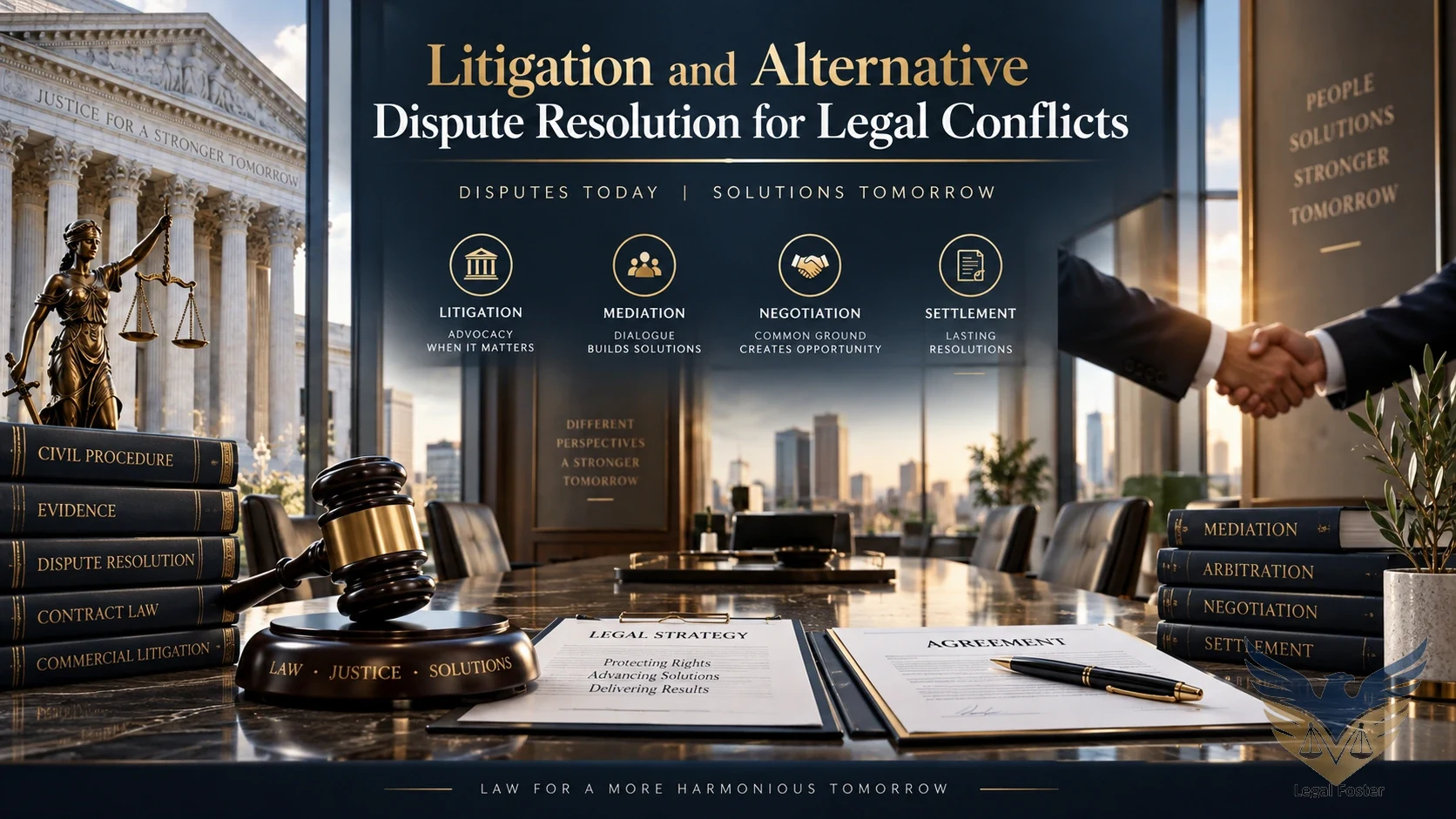
Litigation & Alternative Dispute Resolution are the two broad categories to resolve legal disputes. Litigation entails bringing disputes to courts/judicial forums. Alternative Dispute Resolution (ADR) focuses on resolving disputes through Arbitration, Mediation, Negotiation, Conciliation etc.
Businesses, Entrepreneurs, Investors and Individuals generally tend to approach a Lawyer when they realise that informal discussions are no longer serving their purpose. It is imperative to understand at this stage which dispute needs to be settled in Court and which dispute can actually be resolved through a structured dispute resolution process. We analyse the disputes, review contracts, understand the remedies available to you and the other party and suggest you the best legal course to resolve the matter. Decision to proceed with litigation or ADR is made after understanding time-sensitivity of your matter, need for confidential resolution, relationship with the other party involved, financial implications and enforceability of remedy awarded to you.
Commercial establishments and individuals located in Delhi NCR, Mumbai, Bengaluru, Chennai, Hyderabad, Kolkata, Pune, Ahmedabad and other cities face disputes with vendors, customers, employees, shareholders, lenders, partners at various stages.
BK Singh Advocate provides you legal consultation for commercial disputes. Our aim is to help you understand your rights, risks and options under the law so that you can make an informed decision on how you wish to proceed further.
Related Corporate Legal Services:
Businesses dealing with disputes arising from agreements may also review Contract Management and Corporate Commercial legal services.
Why Does Dispute Resolution Matter for Businesses in India in 2026?
Commercial disputes are becoming more frequent and complex as a result of globalisation of trade, e-commerce, international transactions, and increasing number of contracts being entered into by companies every day. When a commercial dispute occurs, businesses need an efficient solution to resolve their issues and get back to business.
Late payments, failure to deliver goods or services, shareholder disputes, or disagreements regarding the terms of a contract can affect your cash flow and business reputation. Businesses are turning to Litigation as well as Alternate Dispute Resolution (ADR) techniques to understand their options when entering into a dispute.
Your Litigation Lawyer will help you understand your options for resolution through the courts and an ADR professional will help you understand your options for negotiated resolutions if appropriate.
Some common types of commercial disputes include:
- Business Litigation
- Contract Law
- When creditors do not receive payment from vendors or suppliers
- Partner and shareholder disputes
- Arbitration
- Business Debt Recovery Disputes
- Employment Law
- When an employer and employee cannot resolve their issues
- Consumer disputes
- ADR
- Mediation
Every case is dependent on its facts. Sometimes mediation is ideal but sometimes the issue needs to be resolved through court.
Related Services:
Employment-related conflicts can also involve Labour & Employment legal assistance, while financial disputes may overlap with Banking and Finance matters.
Quick Facts About Litigation and Alternative Dispute Resolution
- Litigation includes ALL form of dispute resolution mechanisms which are conducted before Courts/tribunals.
- ADR normally means arbitration/mediation/conciliation/negotiation.
- Arbitral awards can normally be executed through a court of law.
- Mediation It is a process where disputes are settled amicably on a mutually agreed terms.
- India has its own Arbitration and Conciliation Act, 1996 which govern arbitration and conciliation in India.
- Commercial Courts Act, 2015 would also apply for commercial disputes depending on facts/applicable law.
- Factors like facts/documents/time-sensitivity/legal rights would decide the dispute resolution mechanism.
What Is Litigation and Alternative Dispute Resolution?
Litigation (Litigasi) and Alternative Dispute Resolution(Penyelesaian Sengketa Alternatif)
Litigation refers to the process of resolving disputes through courts or any other existing forum. Alternative Dispute Resolution ("ADR"), is the ability of parties to resolve a dispute through available mechanisms without resorting to litigation.
Both ADR and Litigation have advantages and disadvantages.
You may wish to consider Litigation when :
- You need court orders/enforcing your legal rights
- Need fast protection relief
- Negotiations have broke down.
You may wish to consider using ADR when :
- You want to maintain confidentiality
- Maintaining business relationship is your objective
- You want a speedy solution
- Both parties are willing to negotiate.
Your Corporate Law Firm will analyze the facts and advise you on the best course of action.
Related Corporate Service:
Companies considering transactions alongside dispute-resolution concerns can also explore M&A and Private Equity legal services.
How Is Litigation Different From Alternative Dispute Resolution?
- Litigation vs Alternative Dispute Resolution
- Usually decided by the court or another adjudicative body.
- Decided by arbitration, mediation, or negotiation.
- Means resolution
- Bound by the rules of procedure and evidence. Often more flexible.
- Usually concludes with a judgment rendered to the parties. Can conclude with parties agreeing to a resolution.
- Court proceedings are usually open to the public. Most ADR services are confidential.
- Depends on your circumstances.
What Types of Disputes Can Be Resolved Through Litigation or ADR?
Contract Disputes with Vendors, Suppliers, Service Providers and Customers
Your business can encounter contracts with vendors, customers, service providers or business partners. In the event there is a disagreement with payment terms/ performance/ breach of contract you may require a lawyer.
The attorney will review the contract, correspondence, invoices and any other information to assess what remedies you may have.
Contract-Related Legal Support:
For contract drafting, review and management concerns, see Contract Management.
Business Recovery/Collection Disputes
If a client does not pay on time it can affect your cash flow. This can be devastating to small and medium sized businesses. You may have several legal remedies such as commencing recovery/proceedings, a commercial claim or participating in a settlement discussion.
Partnership and Shareholder Disputes
Disputes between business partners or shareholders can affect your business. There are some situations where this can be resolved using mediation/ arbitration.
Employee/Employment Disputes
Employment agreements, terminations, non disclosure agreements and employees suing your business are some examples of disputes.
Like any dispute ensure you have all your paperwork in order and have your lawyer review what happened prior to deciding if you need to litigate or use ADR.
Related Business Services:
For businesses and entrepreneurs dealing with ongoing legal requirements, the Startup Advisory service may also be relevant.
What Documents Are Required for Litigation and ADR Proceedings?
Documents can play a crucial role during a dispute. Your lawyer will usually want to review all pertinent documents before determining the legal strategy to be adopted.
Documents that may be useful include:
- Agreements between the parties
- Purchase orders, contracts, invoices
- Proof of payment, bank statements
- Correspondence (emails, notices, business letters)
- Partnership/ shareholder agreements
- Any arbitration clause
- Previous legal notices
- Any previous court order /litigation
It is important that businesses keep adequate records from the beginning. This can affect the outcome of your claim or defence.
BK Singh Advocate will review all relevant documents related to your dispute and provide legal advice on your rights before embarking on litigation or ADR.
Related Compliance Service:
Businesses reviewing dispute-related records and compliance obligations can also consider Audit Diligence and Compliance services.
When Should You Consult a Litigation and ADR Lawyer?
When someone else’s actions affect your interests, you should talk to a lawyer. Your interests can be money, rights under a contract, business interests or something else. Here are some scenarios where you should speak with a lawyer.
About to sign a contract.
Let a lawyer review it. They will ensure it contains clear terms, a dispute resolution clause and no hidden risks.
Got a letter from a lawyer.
Don’t ignore the letter thinking it will go away. That will only cause more problems. Have it reviewed so you know how you should respond.
Breed a contract.
Maybe the other side didn’t pay you what they were suppose to, or they didn’t deliver goods or services. You may need to file a lawsuit to recover what you are owed.
You’ve attempted to negotiate.
When you have spoken with the other side and can’t come to an agreement. An attorney can help you figure out if filing a lawsuit or arbitration or something else is needed.
Too often businesses wait too long before speaking with a lawyer. They think things may resolve itself. By waiting you can lose your ability to collect evidence, what you can recover, etc.
How Can Corporate Law Firm and BK Singh Advocate Help?
Litigation/ Dispute Resolution services strive to balance legal rights with commercial reality. Whether your dispute involves your business, company, individual or organisation BK Singh Advocate can help. Services include:
DISPUTE ANALYSIS Tell us the facts, agreement, correspondence and what you want to achieve.
PLAN Based on the dispute, we will advise you on the nature of your dispute. There may be a number of options such as negotiation, mediation, arbitration or litigation.
LETTERS We will professionally draft any notices, claims, replies, petitions and any other legal letters to explain the matter.
ADVOCACY You may require someone to speak on your behalf before Court, Tribunal or at Arbitration dependent on the dispute.
At BK Singh Advocate our aim is to protect your interests and ensure that any course of legal action you decide to take is practical.
Related Service:
Intellectual property disputes may also require specialist assistance through Intellectual Property legal services.
Frequently Asked Questions
1. What is Litigation and Alternative Dispute Resolution ?
Answer: Meaning of dispute resolution through Courts is Litigation. Arbitration, Mediation, Negotiation and Conciliation are known as Alternative Dispute Resolution(ADR).
2. Litigation or ADR which is good?
Answer: Each dispute is different and depends upon facts. Some disputes have to be settled only in courts and some disputes can be settled out of courts through Arbitration, Mediation, Negotiation or Conciliation.
3. Which disputes can be settled through ADR?
Answer: Purely commercial disputes such as contractual disputes, disputes regarding payments, partners disputes and in all kinds of business related claims (legal restrictions apply) can be settled through ADR.
4. Is arbitration award final and binding?
Answer: Arbitration award are enforced through Arbitration and Conciliation Act, 1996 and through law.
5. Can we go for arbitration instead of going to courts?
Answer: Yes arbitration can be done if there is an arbitration clause in your agreement or both parties agreed to resolve their disputes through arbitration as per law.
6. When should I File Commercial dispute?
Answer: When you have tried your negotiation skills and if your contractual rights are affected or you need a legal notice or relief from courts you should go for Litigation.
7. How mediation can helpful in settling business disputes?
Answer: Mediation is a process where parties sit across a table with a neutral person called mediator and try to see if they can settle their dispute.
8. Which documents should I bring if I want to file commercial litigation?
Answer: You should bring Contract/ Agreement/ invoice/ Proof of payment/ Correspondence/ Notices/ Any other document which was shared between during transactions.
9. Can I get help for arbitration from BK Singh Advocate?
Answer: Yes you sure can. We provide arbitration and dispute resolution related assistance and guidance.
10. Why I should hire a Corporate Lawyer for my dispute?
Answer: You should hire a Corporate Lawyer to understand your legal risks in a dispute, what remedies are available to you and what is the best way to resolve those disputes as per your facts.
Final Thoughts
Commercial disputes should always be reviewed by an attorney. They involve multiple risks and potential liability. There are multiple ways to resolve a dispute whether through Litigation or ADR. It is important to understand your options and select the best method to fit your needs.
As a business, entrepreneur or individual if you find yourself faced with a possible dispute, speak with an attorney right away. Corrective documents, acting in a timely manner and preparing for the appropriate dispute resolution can help you save valuable rights and business interests.
BK Singh Advocate can assist you with commercial disputes, litigation, arbitration, mediation and more. Contact us with any legal matter.
Additional Related Corporate Services:
Businesses requiring intellectual property protection can explore Intellectual Property.
Businesses requiring employment-related legal assistance can explore Labour & Employment.
Companies requiring regulatory and record-based review can explore Audit Diligence and Compliance.