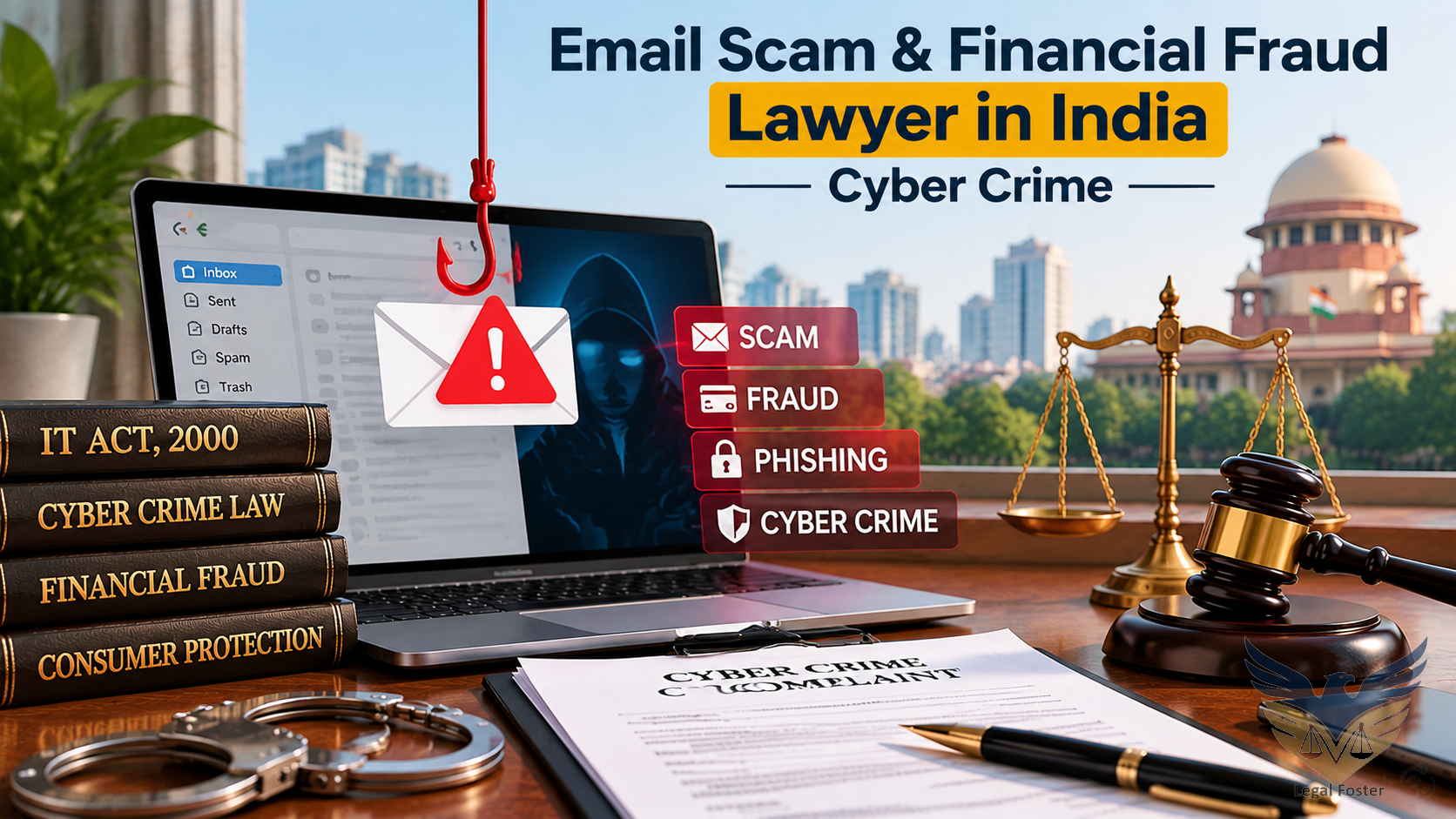
An email scam can seem like a genuine email, use a familiar logo, address you by your first name and use the name of your manager. Despite all these boxes being checked, it can still be part of elaborate financial scam. The person may not even know they are a victim of fraud until their money is gone.
Any person, employee or business in Delhi NCR or India can potentially face financial and legal consequences as a result of an email scam. The criminal offence could be cheating, impersonation, identity theft, hacking into a computer resource, doing a fraudulent electronic transaction, or something else depending on the circumstances.
Act Quickly – Report Email Financial Fraud In India
If you are a victim of an online financial scam, make sure to preserve all electronic evidence of the scam and report the crime immediately. With respect to cyber financial scams, the Indian Governments National Cyber Crime Reporting Portal even has an entire section dedicated to telling victims of cybercrime to report their fraud complaint immediately by calling the 19 thirty cybercrime helpline.
Always consider the facts for any legal analysis. An email scam where someone poses as your bank may create different legal concerns than a business email compromise, phishing email scam, fake invoice scam, or stealing someone’s login credentials.
Visit Advocate BK Singh & Associates site
Consider filing a criminal complaint along with reporting the scam as financial fraud. A complaint is not just about stirring the bear. Electronic record could be valuable evidence during investigation.
Why Email Fraud Should Be Taken Seriously In India In 2026?
Email scams aren’t always shady emails asking for your password or payment for lottery winnings. Emails can be spoofed to look like they come from your suppliers, employer, bank, customers, lawyer, government department, or even your own bosses.
Imagine getting an email seemingly from your director or head of accounts asking one of your employees to transfer money to a “new account.” By the time your business figures out the account ID was spoofed the money could be long gone to other accounts.
Delhi NCR businesses, startups, and professionals may also conduct a lot of financial transactions online (through online banking, UPI, approving payments through email, using cloud based workflows, accepting digital paperwork). Which means there can be additional, tangible risks.
Visit Advocate BK Singh & Associates site
Consider filing a criminal complaint along with reporting the scam as financial fraud. A complaint is not just about stirring the bear. Electronic record could be valuable evidence during investigation.
QUICK FACTS
India has a National Cyber Crime Reporting Portal where cyber financial fraud can be reported
The National Helpline Number Against cyber financial frauds in India is 1930 .
Bharoya Nyaya Sanhita, 20 23 has relevant provisions relating to cheating and cheating by personation.
Identity theft and cheating by personation using computer resource or communication device has been covered as offences under Sections 66C and 66D of Information Technology Act, 2000 respectively.
Electronic and digital signatures have been given evidentiary value under the Bharatiya Sakshya Adhiniyam, 2023.
Information in respect of a cognizable offence, may be given orally or by electronic mode to a police officer, under section 173 of Bharatiya Nagarik Suraksha Sanhita, 2023, as the case may be, and subject to compliance with the conditions required by this Act.
Don’t bank on your money coming back as soon as you file a complaint. Recovery of money is not instantaneous on filing of complaint.
What Is Email Scam?
An email scam is fraudulent email correspondence that attempts to trick the receiver into divulging information, sending money, impersonating another person or performing some other illegal action.
Fraud is a financial crime committed when an act of deception, or some other dishonest conduct, causes or attempts to cause loss of money. Whether something is criminal depends on what happened, who did what to whom, with what information, how the victim was deceived and if money or property was transferred because of that deceit.
Email scams may include malicious document attachments, requests for bank payments to be made, fake supplier emails, stealing confidential credentials or redirecting a victim to a fraudulent payment site. Scams can be sent through email.
Email does not always equal the same criminal offence. Oftentimes, it comes down to the evidence and actions taken. Don’t ignore the scam, take note of it.
Which Legal Provision Apply to Email Fraud?
There are a few legal provisions that can apply when dealing with cyber-fraudulenc during the investigation or prosecution. While many scams may include the use of email, prosecuting the scam will not depend on the email, but rather what actually happened.
Bharatiya Nyaya Sanhita, 20 23
As mentioned above, the Bharatiya Nyaya Sanhita, 2023 is already part of our criminal-law framework. It will come into effect on 1 July 2024.
Section 318 of BNS is the cheating provision. This section deals with cheating and can be invoked where someone dishonestly induces the victim to deliver any property or to do anything which he knows to be fraudulent under circumstances mentioned in the section. There are punishments for various types of cheating.
Section 319 deals specifically with cheating by personation.
Both of these provisions could apply in cases where someone impersonates another person. For instance, if a fraudster poses as a bank employee, business agent, customer, employee or any person for the purpose of tricking the victim into sending money or transferring assets.
Information Technology Act, 2000
This Act will continue to apply to several offences that occur over computer resources or the internet.
Section 66C deals with identity theft. This section applies where someone dishonestly or fraudulently uses the electronic signature, password, or any other unique identification feature of another person.
Section 66D creates criminal liability for cheating by personation using computer resources or communication devices.
It really depends on what happened, and where the evidence lies to what provisions will apply.
Bharatiya Sakshya Adhiniyam, 2023
Email accounts, messages and emails are themselves admissible as evidence. This can include bank transfers, documentary evidence stored in digital formats, screenshot of calls or texts, or any other electronic-documents.
Section 61 of the Bharatiya Sakshya Adhiniyam, 2023 provides that any electronic or digital record is deemed to be evidence and has been given legal evidentiary value. However, this evidence can be challenged or proved as per Sections 62 to 73 BSMA.
Trying to delete your original email or doctor screenshots will only get you into unnecessary evidentiary troubles. Preserve the evidence.
Who Needs A Lawyer For Email Scams?
You may need legal help if:
* You have sent money because of a fraudulent email
* You provided bank details to a scammer
* You are the victim of an unauthorized payment
* You received a fake invoice/payment request
* You are the victim of business email compromise (BEC)
* Your email account or online identity has been hacked
* Someone has been impersonating you and emailing customers or suppliers
* Money is missing from your business account
* You have been accused of conducting a fraudulent online transaction.
Businesses should also be aware of employees who may have followed instructions to transfer money because of a scam. In addition, there could be potential internal violations if your processes were not followed.
If you have been affected by an email scam, the answer is pretty simple. You may be wondering, what do I do now? What evidence should I not delete? Here are some basic steps to follow.
How To Respond To An Email Financial Fraud?
Once you know you are a victim of an email financial fraud, immediately Report it, preserve Evidence and notify the Bank.
Report: File a complaint if you are the victim of a financial cyber fraud. You can report the crime online via the 19 30 cybercrime helpline or on the National Cyber Crime Reporting Portal. Under the cybercrime portal, you can click on the financial frauds section to report financial cyber crimes. File Complaint Online. Your complaint will be routed to the cyber cell or law-enforcement agency in your local area.
Notify: You should notify the bank, payment processor, or financial institution that was impersonated as soon as possible. Make sure to keep a copy of your complaint, the transaction information & all correspondence.
You may also need to file an FIR or speak to a lawyer about any additional legal remedies. As mentioned earlier, any information in respect of a cognizable offence committed, or making a complaint or providing information received in an electronic mode, shall be reduced to writing by a Police officer-in-charge. In plain English, you’ll most likely have to file an FIR.
Don’t speak to the suspected scam artist outside of your bank. If he promises to return the funds, make sure to report that to your investigating officer and bank. A record of this conversation could help you.
What Evidence You Should Keep?
Preserve Evidence. Evidence is always going to help your case.
Email: Try to keep the original phishing email. Don’t just take a screenshot. Keep any documents attached to the email, email address it was sent from, the subject of the email and date and time of the email. Keep the conversation history.
Transaction: Keep bank statement or transaction id number (if available), UPI information (if used), beneficiary information, payment receipt and any account records that detail the payment.
Company: Keep any emails authorising the payment, purchase order, invoice, vendor emails, employee emails and anything that shows who approved the transaction.
You can also keep:
Screenshots of the phishing website/payment portal;
Phone numbers the perpetrator used;
Any WhatsApp or SMS conversations;
Suspicious urls / website names;
Login alerts / bank account notifications;
Bank statements, bank transfers;
Emails received from your bank/wallet;
Complaint reference number;
Information about the person who identity was stolen.
Do Not alter original electronic documents. Let your lawyer do that. Your attorney will help you gather the evidence and prepare it for legal proceedings.
How Does Legal Process Usually Work?
Generalized steps for legal recourse normally initiate with preservation of evidence/reporting of transaction. The report is analyzed by law enforcement agency, Cyber Crime trails are determined by investigating bank records, digital messages, WhatsApp chats, emails account details & other digital evidence.
The investigation will take place, suspect may be identified, evidence collected and/or criminal prosecution initiated. The exact process will vary on a case-by-case basis depending on the facts, potential offences, territorial jurisdiction and evidence.
As stated by NCPCR, These Complaints are sent to Law Enforcement Agencies for verification and investigation based on the information provided by the complainant in the online complaint. Click Here To Read Full Notification.
A lawyer will explain how the law applies to your facts. They may help organize your documents, draft necessary representations and go over your legal rights and options. Lawyers do not know how long it takes to recover your money. As soon as you know something is fraudulent report it.
What Documents To Prepare?
If you already have evidence, organize it by date. You may only have the email. That’s okay.
Print screen of email.
Print out bank statement or transaction ids.
Email screenshots showing any proof of payment.
Keep confirmation of your complaint to the police or cyber crime cell.
Correspondence with bank or payment provider.
If a business was involved, there may be more documents you need. Get the invoice/purchase order with company vendor details. See who authorized the transaction and what emails were communicated between employees.
If someone’s identity was used, preserve what evidence you can of the actual person and the fraudulent transcript. Evidence would include emails sent by the real person and keep original documents/electronic records.
When Should You Consult A Lawyer?
If a lot of money is involved, you should speak to a lawyer. Other times include if the scam involved a business bank account, multiple transactions, someone’s identity was used, confidential information was shared, the police/bank dismissed your complaint, you received a notice or someone is accusing you of being involved in the transaction. Additionally, if you are now involved in a criminal investigation you may want legal advice.
Advocate BK Singh will go over the documents you have and explain your legal options based on the facts. You should consult a lawyer to learn about:
The law
What evidence you should preserve
The procedure you should follow
What legal remedies are available to you.
Don’t go expecting your lawyer to promise you a recovery or that you will win. Learn what your legal options are and decide how to proceed.
How Can Advocate BK Singh Help?
Advocate BK Singh can help you if you’ve been the victim of cyber financial fraud in Delhi, New Delhi, Ghaziabad, Noida, Gurgaon, Faridabad, Meerut, Hapur or anywhere else in India. The law allows you to file a criminal complaint, determine if there are legal issues with your transaction and resolve matters accordingly.
Legal options may include reviewing the facts of your cyber financial fraud, identifying potential legal issues with the transaction, reviewing criminal law and cyber law issues involved in a potential claim, examining any complaints you’ve filed, organizing your electronic evidence and explaining your overall procedural options.
If a business has been impacted by a fraudulent transfer, it may also be necessary to review contracts, company approval procedures, vendor correspondence and full transaction history.
The ideal solution or outcome will depend on the facts. Only a qualified legal professional can properly review what the law allows, what police can investigate, what banks can do, and what recovery you can actually pursue.
For business-related fraud and payment disputes, Corporate, Commercial & Taxation legal services may also become relevant depending on the facts.
Where the matter requires court intervention, High Court remedies may be relevant depending on the nature and stage of the proceedings.
In matters that reach the apex court, Supreme Court representation may become relevant depending on the available legal remedy.
Where a company or corporate dispute is involved, NCLT proceedings may become relevant depending on the facts and applicable law.
Financial disputes involving banking transactions may also overlap with Banking Recovery & Loan Settlement issues in appropriate circumstances.
Depending on the contractual framework and nature of the dispute, Arbitration & ADR may also form part of the available dispute-resolution framework.
FAQ’
Q1. How do I report an email scam in India?
Ans. You can report email scam in India on the National Cyber Crime Reporting Portal depending on the facts. Emails scams that consist of financial fraud can also be reported to 19 thirty.
Q2. What should I do if I transferred money to a scammer?
Ans. If you have lost money, contact 1930 and report financial fraud. Then notify your bank or payment provider. Preserve the original email you received and proof of the transaction.
Q3. Can I use an email as evidence for a criminal case?
Ans. Yes. Electronic records can be used as evidence in India. Which means your email has potential legal evidentiary value under the Bharatiya Sakshya Adhiniyam, 2023. However, they will have to comply with the conditions required under BSMA for electronic records to be admitted as evidence.
Q4. What is Section 66D of the Information Technology Act?
Ans. Section 66D of the IT Act addresses cheating by personation using computer resources or a communication device. Section 66D will apply depending on the facts and if the ingredients are satisfied in the matter.
Q5. What is identity theft under the IT Act?
Ans. Section 66C of the Information Technology Act, 2000 addresses identity theft.
Q6. Can I file a cheating case for an email scam?
Ans. Criminal cheating provisions under the BNS can apply to email scams if the facts establish that cheating or cheating by personation occurred. Sections 318 and 319 may both apply depending on the facts.
Q7. Will the police return my money if I file an email scam complaint?
Ans. Just because you filed a complaint, does not mean your money will be returned to you. Filing a complaint can help with investigations and can help the investigating agencies with money tracing efforts. Recovery will be determined by facts, transaction traces, availability of funds and the investigative efforts by the agencies and bank.
Q8. Can I delete an email after reporting it to the police?
Ans. After you report the email to the cyber cell, you can delete it. No, not really. Do not delete or edit the original electronic mail you received. Print out the email or save it as a document. Preserving all evidence is best.
Q9. Can a company sue for receiving a fraudulent payment request?
Ans. It depends on the facts. Perhaps, yes. Your company may need to review the payment trail, who signed off’ on the payment, email exchange between the parties, bank details and determine how the fraudulent transaction occurred. From there, your company will know what actions they need to take.
Q10. When should I contact Advocate BK Singh?
Ans. Contact Advocate BK Singh if you lost money, gave away confidential information, had your account hacked, want to file a cybercrime complaint or police complaint, or need legal assistance if the matter turns into a legal dispute. Advocate BK Singh will review the information you have and explain your legal rights.
Conclusion
Emails from cyber criminals can seem innocent. You may open an email and it leads you to make a bank transfer, give away personal information or become involved in a criminal and financial dispute. The best thing to do is usually act quickly, preserve the evidence and report the fraud to the correct authorities. India has a 19030 helpline and National Cyber Crime Reporting Portal to help victims of cyber financial fraud. You can usually determine how serious a matter is within the first few steps. Meaning your lawyer can explain what offences apply to the facts, what evidence you should preserve, how to file a complaint, and what legal remedies are available. Advocate BK Singh can provide a free assessment of your situation without generalizing that all cyber-frauds go the same route.