Default Bail Under BNSS Legal Rights of Accused After Investigation Delay
A man is arrested, produced before Magistrate and sent to custody. Weeks turn into months. His family inevitably wonders: When does law say that an investigation has lasted too long?
The answer can decide bail in hundreds of criminal cases. It depends on a set period for investigation and filing of police report.
Section 187 of Bharatiya Nagarik Suraksha Sanhita, 20 23 (BNSS) lays down the statutory period to complete investigation in most offences. Default bail under BNSS kicks in to safeguard an accused from oppressive further custody when the investigating agency did not complete investigation within applicable statutory period.
See Benguluru MLA Satish Jarkiholi Attacks Police, Said “You Will Never Take Bail” From Me
Unless the police report is filed within-
(a) ninety days, where the offence punishable with death, imprisonment for life or imprisonment for a term of ten years or more, or
(b) sixty days of the date of arrest of the accused person in custody, the period within which investigation shall be completed
the offence shall be investigated-
WhatsApp Helps SC Save Five-Year-Old Girl From Rape, Proceedings Punish Everyone Involved
Section 187(3) BNSS says bail will be simply granted if the accused “is prepared to and does furnish bail” if these periods expire.
Sounds simple? It’ isn’ necessarily so.
Figuring out the deadline requires care because details can include the official reason for each remand, the possible punishment for the offence, when the clock starts running for purposes of investigation, whether the police report was filed already, and more. Sometimes a separate criminal law prescribes its own investigation period. If police file charge- sheet within stipulated period, it changes the legal position further.
So if you or a loved one happen to be arrested anywhere in India, read this once before working out the deadline. Don’t lazily count calendar days to figure out a deadline. See the court record. Attorney BK Singh focuses on the relevant FIR, custody timeline, remand orders & applicable law instead of guessing at a deadline.
Why Default Bail Matters in Delhi NCR and Across India in 2026?
Default bail comes into play when the accused is in prison while investigation is ongoing. Some families assess how strong the charges are against their loved one and think that strength of allegations alone decides if they will get bail or not. That is only part of the legal strategy.
Investigation
Duration of custody and statutory period for default bail is another separate issue altogether. Custody while investigation is ongoing is governed by Section 187 BNSS. The Section specifically mentions the 60- day & 90- day default bail timeline for general category offenses which fall under the said section.
Action.
Because we are in Delhi NCR, the logistical issues add to the confusion. The FIR may have been filed in X district. The accused may reside in Y city and his family could be trying to keep up with police, jail and courts in multiple locations. You could have a case pending in Delhi and living in Ghaziabad. Your neighbor could be in Noida tracking a Faridabad case.
Bail timeline would remain the same across India since its a statutory scheme. But the actual court where case gets filed, process to file default bail petition, where to find out custody is recorded, facts of the case will be local issues.
If the accused person is reaching his statutory deadline, involving a lawyer at the onset would work better than the family realizing the default bail angle after charge- sheet is submitted.
Quick Facts
187\. BNSS Contemplates Remand during course of Investigation when canot be completed within 24 hours. :-.
- The period of 90 days is granted in case of qualifying serious offences.
- The period of 60 days is granted in case of all other offences under Section 187(3).
- The accused has to be prepared to furnish bail and he shall in fact furnish bail to get his release u/s 187.
- Default bail is not bail on merits.
- Accused is not entitled to acquittal, discharge or termination of criminal proceeding against him on default bail.
- Different period may be provided for investigation under special statutes with additional conditions.
What Is Default Bail Under BNSS?
Default bail means bail that is available to you by operation of statute. It may become applicable when Investigation Agency fails to complete investigation and file requisite police report within time prescribed under law.
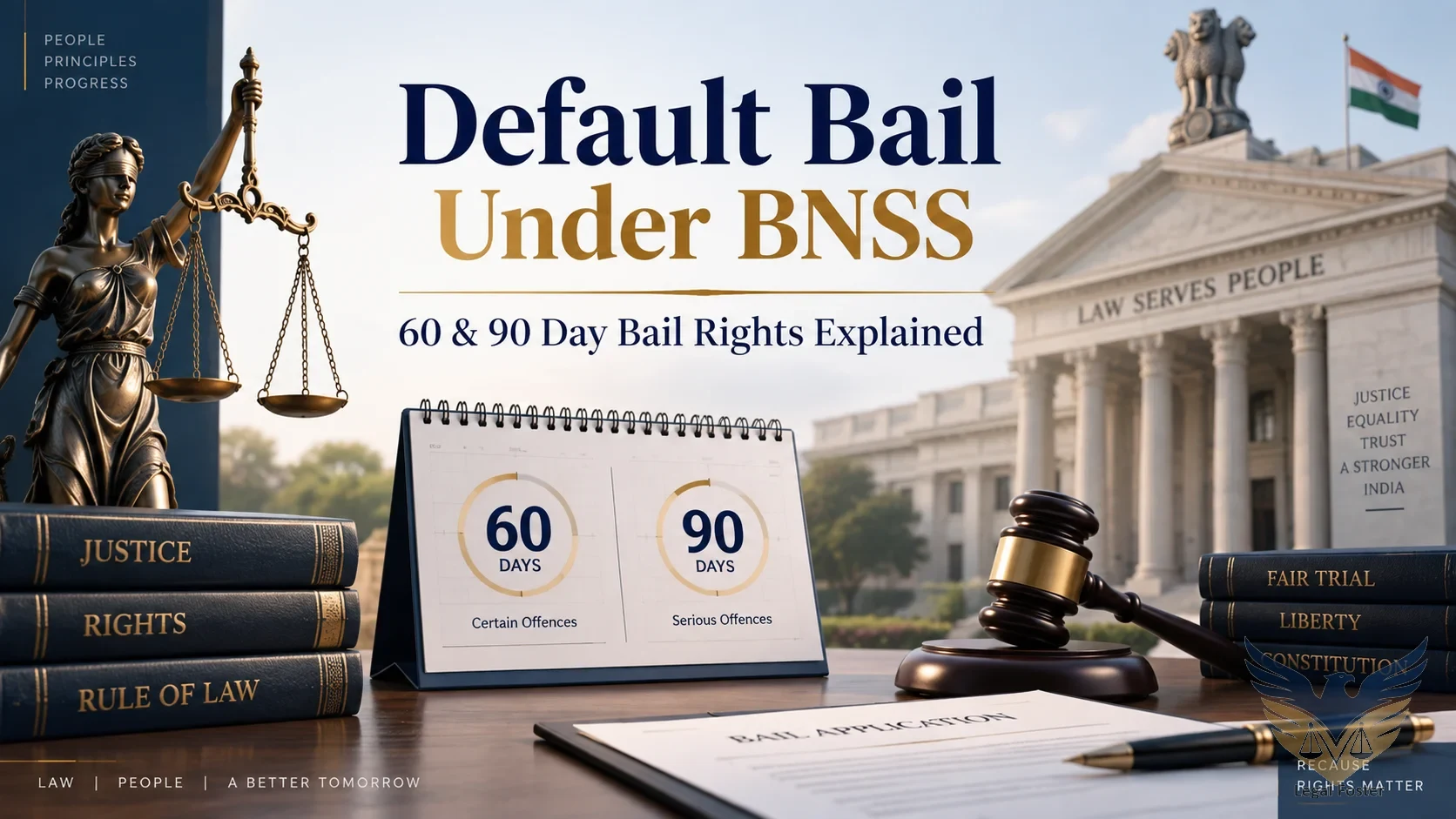
Section 187(3) BNSS contains provision stating time limits. Section says period of 90 days is prescribed for offences which are punishable with death, imprisonment for life or imprisonment for ten years or more and period of 60 days for any other offence. Upon expiry of relevant period, accused shall be entitled for bail on default if all other conditions requisite to obtain bail are complied with including his willingness to give bail.
Default bail should not be mistaken with ordinary bail to which we are all familiar.
Regular bail is when you request the court to release accused on bail on merits i.e. after going through facts, allegations, nature of custody, evidence if any, circumstances etc. Default bail works on a different statutory mechanism which gets triggered when investigation agency fails to file investigation report on time.
Default bail also does not mean that you are acquitted or found innocent. FIR & prosecution will continue against accused.
What Law Provides for Default Bail in India?
The old provision is Section 167(2) of Code of Criminal Procedure, 1973. Section 187 BNSS contains provisions for remand similarly under the BNSS.
187\. Empowered a Magistrate to authorize detention in custody for a term beyond the first twenty-four hours. Prescribed limit and manner. Sub-section (3) contains the 60/90 day specification for default bail.
The Supreme Court has gone to great lengths previously explaining the importance of this term of statutory custody under the old regime of CrPC. Although it expressly acknowledged Section 187 BNSS to be the substituted provision in its 2025 verdict transitioning the SC to BNSS, the Court nonetheless highlighted that the period would still be of 60-days/90-days.
Must be determined anew according to the offence and special laws. Ex. The NDPS Act, UAPA contain special provisions for the timing of investigation, extensions, bail limitations, etc. Therefore, an attorney should examine the FIR and all relevant statutes prior to analyzing if default bail is applicable.
Precisely why Advocate BK Singh never treats “60 Days” or “90 Days” as a magic number.
Who wants help with Default bail?
Default bail arises where an accused is in custody and investigation is pending. Talk to a lawyer if multiple weeks are being spent in custody; orders of remand are repeatedly being passed; the statutory period is looming; or no one is sure if the police report has even been filed yet. It also requires analysis where new offenses are being alleged during the investigation.
Which offense sentence applies will determine whether 60 or 90 days are used.) Start getting befuddled where special statutes come into play. Standard BNSS math won’t give you the answer if another statute specifies a different period for investigation or imposes additional conditions on bail. For this and many other reasons, in my experience the FIRST place to start is with the court record. Not some napkin math pulled from memory.
How Does the Default Bail Process Work?
Step1: Ascertain the date of arrest & all relevant remand orders are passed. Confirm date mentioned on family records/ papers is the date reflected in the police station papers & court’s remand orders.
Step2: Analyze Offence. Read the relevant punishment provision to ascertain whether it is a 90 day bail case or a 60 day bail matter under section 187(3) BNSS.
Step3: Ascertain that no special statute applies or if there is an extension provision that is legally operative.
Step4: Ascertain if Police actually filed the report/charge-sheet within the relevant statutory period. Verify with court record that it was filed, don’t just take someone at the police station’s word.
Step5: Approach Court for default bail via the relevant procedure and execute bail satisfactory to Court.
And only when you have objectively confirmed that the statutory requirements have been met, then is the accused entitled to default bail. Keep in mind that the Supreme Court has repeatedly admonished us that this is a statutory right and is only available upon compliance of procedure. In fact, the Court took pains to explain its previous judgments under Section 167(2) CrPC to clarify the effect of the lapse of the statutory period and before filing of an intervening report by police.
Advocate BK Singh can analyze the relevant criteria to decide what type of bail is available to you.
Documents /Evidence
Helpful Documents File would generally consist of:-
- Copy of FIR/complaint
- Memo of arrest, if any.
- First remand order
- Subsequent police custody/ judicial custody orders
- Dates/details of every appearance Production before Magistrate
- Applicable penal provisions/special acts applicable.
- Copy of police report/ charge- sheet if filed
- Filing memo/Court copy of filing is available.
- Orders passed on extension of investigation/police custody.
- Copies of previous bail pleas/orders.
- Documents showing purpose/id proofs/address of sureties for bail proceedings.
- Detail of sureties along with documents produced for sureties.
- (See whole set of record as single date can change the computation.)
- Online case- status is useful. But may not show all happenings i.e filing of proceedings.
If time is factor then cross check from original record from court.
When Should You Consult a Lawyer?
You must meet an attorney without delay if-
- the accused has undergone remand for few weeks
- you are nearing 60 days or 90 days period
- family members can't figure out the correct remand dates
- police have informed that the charge-sheet will be filed soon
- new offences are being added against you
- There is a specific law in effect.
- application for bail has already been rejected in your case
- public prosecutor is saying that they can extend it
- family members don't know if police has filed the charge sheet already; or
- Trial is taking place in some other district or State.
BK Singh can go through the record that is available with you and guide you whether the matter is of default bail or regular bail or some other appropriate legal option.
How Can the Best Bail Lawyer Can Help?
At Best Bail Lawyer, your default bail advocate informs you about default bail information and help as well as general bail matters.
Starting from the FIR, if you are in custody he can review the punishment provisions that apply to you, arrest details, first remand order followed by further custody orders and investigation status from the police report.
Advocate BK Singh will look into whether a special and/or customized criminal law provision changes the BNSS plan. Also whether the issue needs to be raised before the time period expires.
Families located outside Delhi NCR sometimes wonder about jurisdiction if the accused has permanent residence in one city and the case is registered in another city. We have information on this subject matter as well as bail issues specific to Ghaziabad and surrounding cities.
Click our bail page and criminal defense page to read about default bail, regular bail and anticipatory bail along with the relevant criminal procedure.
A prudent lawyer will not guarantee that you will get default bail. The right solution is determined by analyzing the facts from the FIR, the statute, custody information, file history and judge’s orders.
FAQs on Default Bail Under BNSS
Q1. What is default bail under BNSS ?
Ans. Default bail is bail written into the statute that becomes available by operation of law if investigation is not completed and charge- sheet is not filed within a period mentioned under Section 187(3) BNSS. The time periods are normally 60 or 90 days depending upon the offense.
Q2. Can default bail be claimed after 60 days?
Ans. Yes. If offense falls in 60 days category and other statutory requirements are met. Please refer court record for exact position as far as calculation and filing are concerned instead of believing someone’s oral statement that charge-sheet was filed.
Q3. When does 90 days time period become applicable?
Ans. Under Section 187(3) BNSS investigation requires 90 days in offenses which are punishable with death, imprisonment for life or imprisonment for a term of ten years or more.
Q4. Is default bail automatically granted if investigation is not completed within 60 or 90 days?
Ans. No. Bail under Section 173(2) BNSS just means time is ripe for claiming default bail. It does not mean that accused will be set free from custody without going through bail process. Accused still needs to apply for bail and furnish bail amounts as mentioned under Section 187 BNSS.
Q5. Does default bail mean that police believes the accused is innocent?
Ans. No. Just because default bail is granted it does not mean the accused is acquitted or that allegations made against him are false. Default bail is just statutory mechanism to secure release of the accused during investigation.
Q6. If I am not eligible for default bail, can I still go to Court for regular bail ?
Ans. Yes. Default bail is directly related to statutory periods mentioned in BNSS for police to complete investigation. Regular bail is looked at independently on merits and facts of particular case. You should not confuse default bail and regular bail as if they are alternative versions of bail.
Q7. Police might file charge- sheet minutes before 60 or 90 days. What happens then?
Ans. Hour matters. Lawyers need to verify court record for filing of charge- sheet and calculate their respective time periods as per statute instead of listening someone saying that charge-sheet has been filed.
Q8. Can default bail period of 60 or 90 days be changed because of special law?
Ans. Yes. Timelines for investigation and bail also changes with special criminal laws. You need different analysis for bail in NDPS cases and bail applications under UAPA as these provisions have to be read with special statutes.
Q9. In which Court should one apply for default bail ?
Ans. It varies from case to case depending on what stage of criminal proceedings the matter is in, what kind of remand order passed, which Court has jurisdiction and what procedural law is Criminal matter pending under. Please stop guessing. Check your case record.
Q10. How BK Singh can help you in default bail matter?
Ans. Advocate BK Singh can review your FIR, history of custody and remand, punishment invite (if any), police report filing status and applicable special-law( if case is related to special statute) to understand which route you should take to apply for bail under BNSS. Court has the discretion to grant or reject.
Conclusion
Do not lose time if investigation is not yet completed. Sometimes default bail under Section 187 BNSS can be a fruitful remedy. Calculation of time starts from date of custody memo being recorded by police and counts 60 days or 90 days depending upon which offense you have been accused for and what law shall apply. Once the clock starts ticking or deadline has already passed it is imperative that you seek legal intervention regarding what is mentioned in your FIR, what orders have been passed by court on remands, etc. BK Singh can review your case and advise you the best bail remedy suited to the facts.
Author Bio
Advocate BK Singh is an Indian criminal-law advocate practicing at Best Bail Lawyer. He specializes in bail matters under BNSS, arrest, FIR and provides help in criminal defense. His practice revolves around case review of default-bail applications (Section 187 BNSS), review of complaints and orders passed on remands by Magistrates, analyzing period of custody for arrest, police-report filings and other procedural laws. Mr. Singh has worked with clients/families all over Delhi NCR and India representing cases from Ghaziabad, Delhi, Noida and many other states. He is someone who believes in studying your case records before taking on your matter. FIR, relevant laws, custody period and court orders are analyzed. Once the facts are clear he advises the right legal remedy. No results are promised for bail or release.