Default Bail Under BNSS: Accused’s Right When Investigation Takes Too Long
It is frightening to get arrested. Being at the other side of the glass wall while your liberty is being curtailed can be even scarier for the suspect and family members who have to visit them while in custody.
The criminal procedural law in India cannot permit detention to continue indefinitely on the ground that investigation is pending and the police have not done their job. There is relief available by statute called default bail under BNSS when police or the investigating agency does not complete investigation and file report required to be filed under law within the prescribed number of days.
Know this cut-off date if you reside in Delhi NCR (Delhi, New Delhi, Ghaziabad, Noida, Greater Noida, Gurugram and Faridabad) and it can legally make the difference for your family member. Same idea applies to every state but the court which is competent to entertain your application, procedure to file and actual practice in courts varies from case to case.
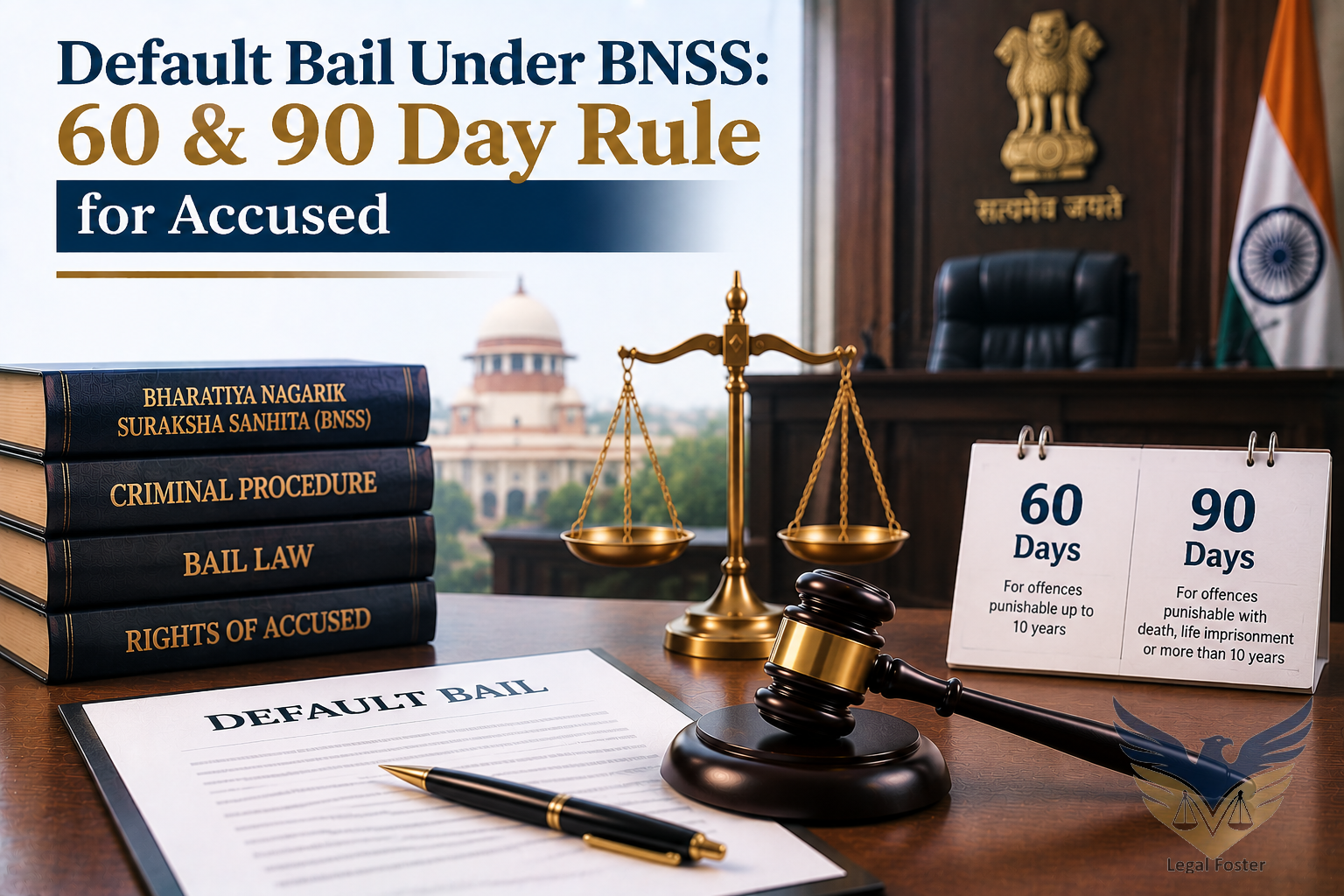
Section 187 Bharatiya Nagarik Suraksha Sanhita, 20 23 (BNSS) is the law which spells out how default bail can be claimed. Go through the statute yourself. The law has granted 60 days for default bail standard cases in Section 187(3). The period for default bail is enhanced to 90 days if the offence is punishable with death, imprisonment for life or imprisonment for ten years or more. Click here to read the statutory language which mandates release on bail if period mentioned above expires and the accused is willing to and offers to give bail to the satisfaction of the Court.
One important thing to note here which is usually overlooked is that default bail is NOT the same as regular bail. Regular bail has a lot of factors to be analyzed by the Court. These factors include gravity of allegations, evidence if any, past criminal history if any, risk of fleeing from justice, concerns about prosecution witnesses and need for further investigation etc. Default bail is granted just because the prosecution took more time than allowed under statute to complete investigation while the accused was in custody.
Esteemed Advocate BK Singh advises you not to try to deduce the deadline using arithmetic on what you remember. Consult the record – Date of Arrest, Date of first remand applied/granted by police/judge, Subsequent orders granting custody, What offences were actually invoked based on complaints/FIR/crustment sheet, Whether police has filed report or not.
Why Default Bail Is Relevant In Delhi NCR and India At Large In 2026?
Your relative’s inability to get out of jail because investigation is taking long affects more than his liberty. He could lose his employment, business opportunities, be separated from his children/family members (depending on who the accused is) and be unable to manage his defense. He might also not be allowed to collect documents or information necessary for his defense.
Secondly, since Delhi-NCR has the unique practical difficulty of the accused person residing in say Ghaziabad/ Noida but FIR registered at Delhi or he may be arrested at one location but produced at court at another location, one would first have to figure out the correct court in which the application needs to be filed depending on the stage of the proceeding.
Courts can range from Magistrate Courts/ Sessions Courts/ Special Courts/ High Courts depending on the offence, who has custody and what relief is needed.
One cannot go to the “default bail court” based solely on someone’s casual comment that “his 60/90 days is over since he has been arrested for 2 months”. You must first calculate the statutory limits based on the records.
Once you determine the offence falls under the category of say 60-days for investigation. You would then have to figure out cut-off date for computing period of custody as per statute. Begin computing the statutory period and then stop to see if police filed report within that time period. You should also check if any extraordinary legislation gives power to extend the time or otherwise alter the normal rule.
Advocate BK Singh recommends you examine the record first rather than go by casual conversations at the police station/lawyers office/home.
Quick Facts
- Defaults get triggered under Section 187(3) BNSS which has laid down the general statutory principle for claiming bail if investigation is not completed.
- 60 Days would be the default time frame, unless the offence falls in the category of offence which mandates a timeline of 90 days.
- Offences which qualify for the category of 90 days include offences which are punishable by death, or life imprisonment or imprisonment of ten years or more.
- Default bail is technical bail in comparison to bail which is granted on merits of accusation against the accused person.
- Accused would have to claim his right under statute and also furnish bail as may be demanded of him by the Court.
- That period can change if there is a special statute dealing with the offence, that specifically provides for a different time period for investigation or specifically empower authorities to extend the same.
- If police files a report contrary to what applicant claims and if the report is filed within the relevant time period, the claim of default-bail stands defeated.
- Defaults are not automatic as one has to go to court to claim his statutory right. Once the default period is over, accused would be eligible for bail if he applies and fulfills the conditions of bail.
What Is Default Bail Under BNSS?
Default bail is bail which accrues by application of a statute. One situation is where an accused is in custody when the statutory period allowed for filing of report of completion of investigation expires and no such report has been filed by the investigation agency.
Section 187(3) BNSS expressly states that on expiry of relevant 60 or 90 days period, the accused shall be released on bail if he furnishes bail and is willing to do so. Bond may be taken from the accused.
This remedy is also known as statutory bail under various decisions. This bail is also referred to as bail by Statues compulsion. However, the terms default bail is used way more frequently in judgments and bail applications in practice.
Just because the accused gets default bail does not mean that criminal prosecution against him comes to an end. Nor does he become acquitted or innocent of the charges.
Which Law Deals With Default Bail In India?
Earlier, default bail was dealt under Section 167(2) of CrPC read with Section 156(3) CrPC.
BNSS came into force on 1 July 20 and has replaced CrPC.
Section 187 deals with procedure and limitations on how long a person can be put in custody by a Magistrate where investigation is pending. Section 187(2) also tweaks the old rule under Section 167 CrPC on how police custody can be granted during initial period of total period of detention.
It depends on the offence. Merely based on what the policeman is telling the person at the police station, we cannot determine this.
Yes. If there is a special law like NDPS Act or UAPA, then those statutes will override BNSS and have their own provisions dealing with investigation and extensions. So ideally a lawyer would first have to ascertain if the accused is being booked under BNSS only or he has been accused of offence which falls under some special statute.
Every recent Supreme Court decision has upheld the importance of custody under statutory limitation and the differences between default bail vs regular bail.
Who Qualifies For This Benefit?
Accused who are in custody and where investigation is nearing the statutory period will be able to benefit from default bail.
Default bail usually arises in cheating cases, criminal breach of trust, forgery, financial crimes, cyber crimes, assault, criminal conspiracy etc. as investigation in these cases take many weeks or months.
Mom/Sisters/Brothers/Wives should be careful when police are asking for repetitive remands or where the accused has been in custody for long periods.
You should consult a lawyer even if you think you have a statutory deadline in the next couple of days. Remember that a difference of 1 or 2 days can mean everything in the eyes of the law.
Lawyer BK Singh will go through your FIR, orders relating to custody and verify the status of police-report to figure out if you have a statutory-bail issue that needs to be raised.
Documents Families should try to collect?
By default, bail by way of defaults is strongest when you have the custody timeline through actual records/documentary evidence. For example:
- FIR and subsequent complaints/orders which added/changed offences
- Memo of arrest
- 1st production/remand order
- Orders subsequently passed for police/judicial custody
- Jail/Custody doc. (Note this document is not always available)
- Copies of any applications you have made to court asking for more custody
- Information on when police report/charge-sheet was filed (from jail records)
- Acknowledgement of filing from court/filing via e-court if available.
- Copy of any application made under special law asking for extension of statutory period. (Can be very crucial)
- Copy of any previous bail orders passed.
- Documents proving identities/address of applicant/sureties
- Documents proving background/salary of proposed surety *
In any event, keep scanned copies of any/orders that are relevant. Checking your case status online will not necessarily show you all orders/filing dates for something that is in contest.
When should you talk to a Lawyer?
You should speak to counsel when the arrested person has already spent few weeks in custody; when police are asking for remand, when police report is about to be filed, when multiple offences have been added during investigation.
You should talk to a lawyer if a special law applies to your case; dates of custody are disputed; if your case has been pending in multiple courts; or if you are not sure whether police have even filed the final report.
Technically speaking, we do not want to find a technicality. What we want is to understand the correct legal position based on the facts that are on record.
Advocate BK Singh would analyse the custody chart,applying provisions,status of charge-sheet and any previous orders passed by judge to advise you if default bail,regular bail or any other remedy is legally available to you.
How Advocate BK Singh Can Help?
Regarding bail, arrest and criminal/FIR related matters, BestBailLawyer will represent you in courts where jurisdiction lies. For default bail issues, Advocate BK Singh will analyze your FIR, first remand order, subsequent orders passed for custody, punishment provisions applying to offences and verify the status of police report.
We cannot guarantee bail results but we can assure you that the right legal remedy will be suggested. Often our clients live in Delhi NCR but require assistance because husband/family member lives at adjoining states – Ghaziabad, Noida, Greater Noida, Gurugram or Faridabad and the criminal case/proceeding is pending at Delhi or somewhere else.
FAQs
Q1. What is default bail under BNSS?
Ans. Default bail becomes available by operation of law/statute when investigating agency does not complete investigation and file report required to be filed within statutory period. Under section 187(3) BNSS, the relevant period will usually be 60 or 90 days depending on the offence.
Q2. If it’s by statute, do I get it automatically after 60/90 days elapse?
Ans. No, not in the sense that police has to set you free without you filing an application in Court. You have to claim your statutory right to default bail and also furnish bail to the satisfaction of the Judge.
Q3. Is default bail the same as regular bail?
Ans. No. Default bail is granted by statute without considering the merits/circumstances of the case. Regular bail is evaluated on a case-by-case basis depending on the facts of the case. The latter looks at gravity of accusation, evidence if any, criminal antecedents, risk of fleeing from justice, threats to prosecution witnesses and need for further investigation.
Default bail is triggered only when investigation is not completed within statutory period specifically mentioned in statute.
Q4. What’s the 90 day default-bail rule?
Ans. Section 187(3) BNSS provides that the mandatory period for filing investigation report is 90 days if the offence is punishable by death, life imprisonment or imprisonment for ten years or more.
For all other offences, default bail will be governed by the 60-day timeline.
Q5. When does the 60/90-day period begin?
Ans. The custody/remand sheet will be the documents which would help you figure out legal date from which you can start computing statutory period. Date of first remand has been considered important based on numerous judgments of the Supreme Court interpreting the old provision.”
Consult a lawyer to carefully assess the dates rather than automatically assuming the date of arrest is day 1 for computation purposes.
Q6. Can police file a charge-sheet after 60/90 days?
Ans. Whether police can file charge-sheet after 60/90 days would depend on whether your default bail right had already accrued under the statute and you claimed the same. Supreme Court has acknowledged that fine but important distinctions exist based on the timeline of when statutory period expires, bail application is made and police report is filed subsequently.
Q7. If I am granted default bail, does that mean I’m innocent?
Ans. No. Just because you got released on default bail, it doesn’t mean your guilt was analyzed and decided by the Court. Your case will proceed after default bail is granted subject to conditions of bail and procedure applicable to trial of the offence.
Q8. Can I claim default bail if I’m accused under NDPS or UAPA?
Ans. Yes. But remember those statutes have their own default period for investigation and process to extend the investigation period. The bottom line is that NDPS and UAPA cases require separate analysis rather than sticking to a default bail 60/90 days calculator.
Q9. Should I file for regular bail instead?
Ans. Default bail and regular bail are two separate forms of relief available to an accused. If you think a statutory right to claim default bail may have accrued, you should carefully analyze that right instead of thinking that a regular bail application would yield the same result.
Q10. Can police take back my default bail?
Ans. Yes. Just because you got released on default bail does not mean you have immunity against future court action. You can lose your default bail due to breach of bail conditions, abuse of liberty, or any other established legal ground to cancel bail.
Conclusion
Section 187 BNSS grants default bail to an accused to prevent the state from unnecessarily detaining him based on pending investigation. That statutory benefit only applies if you correctly ascertain the offence category, period of custody served/computed, complaints filed, law applicable and make an application. Families cannot wait till police come to them a day before the deadline to act. Also, do not expect an accused to be released on bail just because investigation is taking long. Law now provides default bail under Section 187 BNSS. But the actual claiming of default bail would depend on facts of your record. Special laws if applicable, police filing of report, grant of remand by judge and timeline of filing bail application can change the result.